

















Writing Lesson: Outlining from Everyone’s Point of View
Posted in Writerliness on 02/09/2011 12:39 pm by jess As the playwright Wendy Wasserstein once wrote, “It’s disturbing having sympathy with everyone’s point of view.” She was talking from the point of view of one of her characters, but I imagine that it’s the playwright’s predicament, too. Whereas novelists are very much in the head of their protagonists, playwrights are more likely to be in touch with all of their characters (a good thing), not just get stuck making sure the main character’s experience is believable and interesting. I think of this quotation, from Wasserstein’s play Uncommon Women and Others, a lot when I’m writing–but perhaps not as much as I should.
To wit: I was going back through an outline of a work-in-progress, Not that Girl, and saw this comment from my advisor, the great Tim Wynne-Jones. Next to one of the near-final chapters, I had written something like, “…and [protagonist] Jackie has forgotten about Becky by now,” and Tim commented in the margin, “Jess has, too.” And I thought, ye gods, he was so right about that: what was Becky doing in the story at this point? I kept making her mysteriously absent, so either I needed to cut her or figure out what she brought to the story.
I chose the former and decided that I’d outline the novel from her point of view, identifying what she was thinking and doing at each juncture. Lo and behold, it opened up so many things. Maybe Becky, in watching Jackie drift further from her best friend Mel, would seize the opening and try to become Mel’s best friend, and Jackie would have to deal with those consequences.
And speaking of Mel, maybe I should outline the story from her POV, too–and once I did, I realized that the story was less interesting when she commented cattily on Jackie’s choices and would be more interesting if she were a sort of wide-eyed, I’m-not-going-to-say-anything pleaser-type of critic. That way, when Jackie does things like consider asking a guy out (horrors), it would be Jackie’s own internal gender police that makes her hesitate, and that would make for a more interesting journey. And when outlining the story from Zoe’s point of view, I made Zoe much more interesting, too–less flaunting her older-boyfriended status in everyone’s face and more trying to get her due from friends who ignore her because they feel like she’s transgressed.
So thank you, Wendy Wasserstein and Tim Wynne-Jones. Your encouragement, implicit or explicit, to identify what the characters think and want at all junctures has made for a much better story on these shores. Now I just have to go ahead and write the dang thing!
If anyone of you read this and try it out, or have already tried it, will you weigh in? I’d love to hear about your experience.

"Uncommon Women and Others," one of my favorite plays from high school
 As any good Jewish person or FOJP (friend of Jewish Person) will tell you, the title above is the first of the four questions asked at Passover. It was four questions that recently–and thankfully–changed the way I’ve been approaching my work in progress.
 I stress again that none of this should have been a huge revelation. Just like Chazz Palminteri at the end of The Usual Suspects, I started hearing voices and seeing images of people saying the same–voices whose words I could remember with shocking clarity for conversations that happened quite a while ago. Grad School Advisor Margaret: “I’m not saying it’s not working. I’m saying it’s not working yet.” Agent Elizabeth: “I’m not saying to give up on it. But I am sounding an early warning.” Critique group member Jen, over her frothy chai (okay, I’m making that part up; I don’t remember her beverage of choice): “I’m still not buying it.” So–to throw in another question–why was my recent reader able to break through when these great responders–and they really are some of my favorites–couldn’t?
 So anyway, why the great breakthrough with Dane? Part of it, I think, is time; I sent her the second draft, so I’ve had time to live with this story for a while and murder many darlings already. But more than that, I think there’s a power to asking questions rather than making statements. Goodness knows I can be a statement-y person–so eager to convince the writer that my idea is the right one, I might just rush in and declare my insight. However, this might not always be the right choice. Dane didn’t assume she knew what was best for my novel, and I shouldn’t do that for other peoples’.
 There was so much craziness involved revisiting the story, including the fact that the request came while I was travelling [no–traveling; I always misspell that], and I had to ask my partner to brave my Extremely Messy, Filled with Deep-Dark Secret Documents that are Likely to Fall On You Shelf and extract my notes from when I workshopped this piece last summer, along with one of about a bijillion Clairefontaine notebooks. (Do you use these? Are they not a superior piece of notebookture?) A side-note on this challenge is that she succeeded the first time around! Go, A!
 their friend Zoe, previously uninterested in boys, unexpectedly brings an older guy to the movies with them. Then, in the next chapter, I had a guy–an adorable one, unfortunately nicknamed Nathaniel the Spaniel, crossing Jackie’s path and Zoe and Mel strategizing about how Jackie can pursue him. I had this line to the effect of, “I’ve been feeling a little weird about Zoe since the movies the other night, but I’m willing to listen to her advice.”

 For that, I might recommend The Poisonwood Bible, by Barbara Kingsolver, about four sisters stuck on their parents’ mad mission trip to the Congo. Kingsolver alternates perspectives and each girl’s voice is amazingly distinct; we learn about history and geography, we’re moved by the stories, and the problems of Colonialism would spark a meaty discussion. But the book is pretty accessible, and if I get to make students read something, shouldn’t it be something they might not finish on their own?
 Jeffrey Eugenides’s Middlesex might strike a good balance between The Poisonwood Bible and The Passion. A story about an intersex kid growing up in Michigan, the granddaughter of Greek immigrants, this book won a Pulitzer Prize and is both world-broadening and stylistically cool. But is the book a little cold? Would high-school students want to keep going with it?

 I didn’t like a word I’d used yesterday in my chapter, “swath.” It’s the kind of word that would turn me off if I was reading–too studied–and, in fact, when I got to the paragraph with the offending swath, I skimmed over it. Bad sign! I needed a replacement.
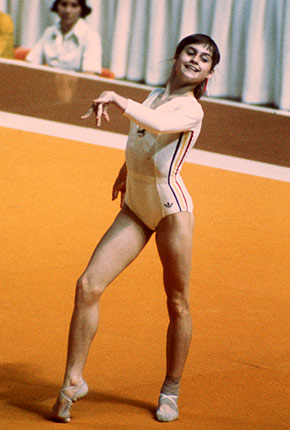 orchestrator; gynecologist; Olympic gymnast)
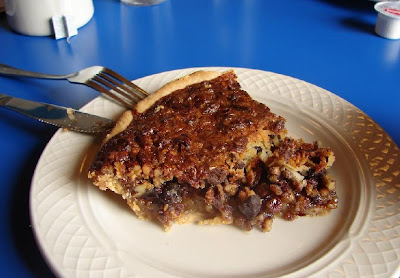 -How it’s Derby season here in Kentucky and there were Derby Pie samples at the grocery store this morning and I almost fainted with delight (Derby Pie=pecan pie with chocolate chips. It is SO GOOD.)